Creating Inner Space

Sometimes life feels too full!

How can that be? Each day holds the same number of hours and the same number of molecules of air. 

Is life too full or am I too empty?

Does that sound like a contradiction? I think not. I think I just hit that nail on the head! My energy is gone.

The cure?
Spend less time doing; spend more time being.
Spend less time thinking; spend more time playing/reading/painting.
Spend less time with others; spend more time alone.

This isn’t the first time I’ve drained my energy reserves, and it probably won’t be the last. Fortunately I believe in giving myself (and others), Second Chances.

Sometimes even two chances aren’t enough to make the changes needed in life.

Rewiring a lifetime of old habits is a big job.

First start with the awareness that more “inner space” is needed. Next add a solid dose of resolve, mixed with encouragement, and a day or two of alone time/me time.

I have ideas, lots of ideas — sometimes even GREAT ideas.

Did you know that time is elastic enough to wrap all-the-way-around our ideas so we can actually MAKE-THEM-HAPPEN?

Down time is essential.

Yet sometimes down time is the hardest thing to “do”. That’s because it’s not so much a “doing thing” as it is a “being thing”.

I have an almost manic “I can do this” mantra running through my head. It’s enough to drive me crazy!
 
Turning off that “mantra” and creating or finding “down time” is critical.

We all need space in order to create. We need the physical space in which to create AND we need space inside our own head and life, an inner space.

Life feels too full when we have no space left within us. We need space in order to create.

“Get in, Get Out, Step Back, Repeat…”

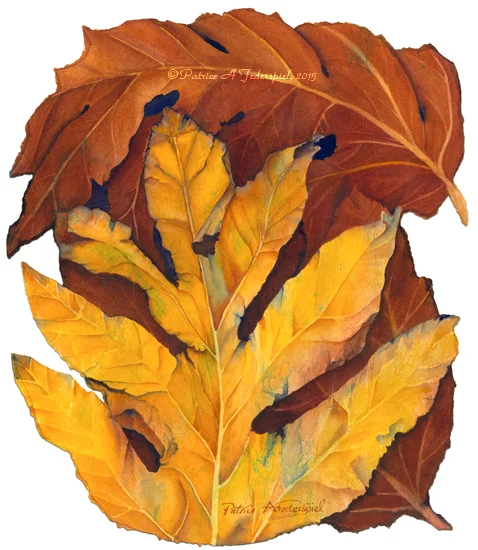
I took just one painting class in college — oil painting. I loved it, but had more fun working in clay, and spent many semesters up to my elbows in “mud.”

Years after graduating, when I decided to paint again, I dug out my old oils. They still held magic.

UluLeaves2Web.jpg

Back then, I was working full time as Creative Services Director, and got up to paint before going to work. That gave me 20–45 min. of painting time about three times a week.

Each day I took a photo of my painting in progress. I liked seeing the painting develop, and knew that I could “blow it” with my next brush stroke. I figured if I had a record of what it looked like when I liked it, I could get back to that stage.

UluLeaves3Web.jpg

Opaque oil paints are “forgiving” because you can always paint over a passage you don’t like.

Watercolors are transparent, so there’s really “no going back”. Instead we continually move forward, adjusting our plans to make use of any perceived mistakes along the way.

I still take photos of my paintings in progress. I like to see the evolution of paintings — and so do my students.

I am both a “fast” and a “slow” painter. My motto is:
“Get in, Get Out, Step Back, Repeat…”

Basically this means that each brush stroke is done quickly, decisively, courageously … and then I STOP, step back, and look to see what’s happening with the painting.

If I know what to do next, I continue on with this “Get in, Get Out, Step Back, Repeat…” method.

Sometimes there’s a long pause between brush strokes. Sometimes it’s because I don’t know what to do next. Sometimes it’s because there is something else that must be done (dinner anyone?).

Most of my paintings take weeks to complete. Even when I think a painting is finished, I put it away for a day or two so that the next time I look at it I have “fresh eyes”.

This is one reason I like to have many paintings in progress at one time. I can easily switch from one to another if I get stuck.

My students long to see me finish a painting in class. Sigh. They want to know how to know when a painting is finished.

Alas, this is a subjective matter.

Robert Genn, a revered master painter from Canada once wrote: “it is better to under paint by 10% than to over paint by 1%.”

Keep painting. The more you do it, the better you get, and the easier it will be to know when your painting is finished.

It’s an unsatisfying answer, yet true.

Broadcasting Happiness

Have you ever felt as though “negative” vibes surround you? 

Do you wonder why all the news you hear is “bad”? Why even call it news, why not call it “only bad news,” which is what it seems to be.

It isn’t always easy to stay positive in a world that seems to celebrate the negative. But that’s “the work.”

A “Power of Positivity” article in “Live Happy” magazine, proposes that the reason we hear so much negative information is that people who feel badly also feel a strong need to verbalize. 

Those who feel good don’t feel the need to share their feelings.

In a weird sort of way it makes sense that we don’t share our happy times more readily.

We’re taught not to boast or to “get a big head”; and everyone knows a big ego is a “bad” thing. 

Perhaps we all compare ourselves too readily to everyone else. When we commiserate with someone else’s woes we might feel better about our own lives. 

Conversely, if we share our good fortune with others, does it make them feel worse about their circumstances?

What an awful, yet plausible thought!

If we did verbalize our good feelings and happy happenstance more often, would good feelings spread?

The aphorism, “a rising tide lifts all boats,” suggests this would happen.

When we share our joys with others, they are supposed to feel happy for us, and realize that good fortune can happen to them too.

With this in mind, I’ve come up with new words for sharing good news. These new words can be a happier version of “commiserate.” What do you think, which are your favorites?

Co-Joyable, Co-Joyate, Co-Joyfully
Co-Gladify, Co-Gladly, Co-Gladuate
Co-Happify, Co-Happiness, Co-Happulate
Co-Celebrate (suggested on FB)
Co-Cheerify (suggested on FB)

Let’s stay “Open at the Top” and let other fun new word combinations come to us to help us spread joy.

Rather than back-handedly lifting others up by sharing our misery with them, let’s lift them up by sharing our happy times and happy stories.

When we share our happiness with others, we increase the happiness all around us. 

Now go out there and Co-Happify the world! — Or Co-Cheerify or Co-Celebrate if you prefer ☺

Cultivate Your Confidence: Part Two

Let’s continue the analogy of planting a garden and growing a watercolor practice. In the last post we ended with you imagining yourself painting, even just for five minutes a day. Now, back to our garden …

If you planted the seeds too close together, you will have to pluck some of them out of the ground to give the others room to grow. If you don’t, all of your plants will be weak and their lives short and stunted.

Sometimes the habits we learn when we first begin to paint seem like the easiest way to keep painting. That doesn’t mean they are good habits to keep.

For example, it might be easier to blot excess water from a painting in the beginning; but it’s not nearly as helpful as learning how much water to use, and how to control it will be later in your painting life.

Practice more painting without blotting.

Even after the seedlings are up and ready to bear fruit, your work continues. There’s the watering, and weeding, and even talking to your garden.

At first you might be fearful about your painting practice. Yet unless you continue to “feed, weed, water, prune, and nurture” your new painting, it will die before it’s had time to grow.

When growing tomatoes, you must pinch off some of the additional leaves to encourage the plant to bear fruit. If you don’t pinch, the plant becomes “leggy” and produces fewer tomatoes.

This same “leggy” or “adolescent stage” happens with paintings too. Don’t worry! We ALL go through this and you can too! Keep painting!
 
Take five minutes each day to look at your paintings in progress. 
Allow for down time between your painting times. During the down times, don’t pick up the brush, just think about your painting.

Allow your mind to get used to the idea of you painting. Allow your hand to hunger for the touch of the brush. You will know when it’s time to paint again.

When that time comes, only paint what you “know” to paint. Let your painting, and your hand guide you to paint. Keep your mind and your inner critic at bay.

Trust only in the process. Trust that as surely as you knew it was time to paint, you will know what to paint next.

Paint quickly and boldly. 
Stop often.
Stand back.
Give your painting space and time so you can see and hear it more clearly.

In this way your confidence in your painting skills will grow.

If your abilities and skills catch up with your ideas, your confidence might slip or your desire to paint could ebb.

If that happens, you have reached your first plateau; you have leveled off. 

It’s time to shake things up. Try a new technique. Take a new class. Learn a new skill. Take your painting to the next level. Paint new and more challenging subjects.

If you don’t challenge yourself, your interest and your confidence will begin to erode.

Cultivate your confidence to keep it, and your paintings, STRONG!