Cultivate Your Confidence: Part One

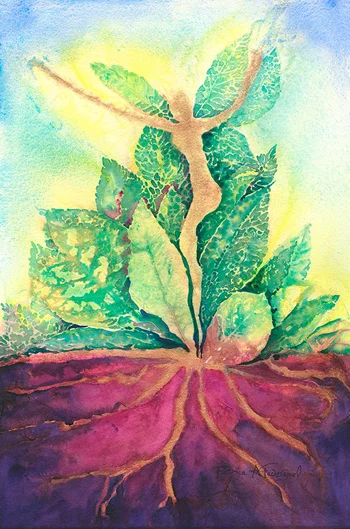
Cultivating your confidence is like cultivating a garden. 

First prepare the soil. Dig it up and turn it over to get it ready for the seeds. The soil needs air to make room for growth.

Do you want to learn to paint? Are you open to the idea of learning something new, something that’s outside your comfort zone? 
Confidence starts as a germ of an idea, a “seed thought.” Our mind has to be ready to accept it or it won’t take hold. Can you believe in your abilities? Can you try to believe in them? 

If so, go on to step two, answer some questions: What is your weather like? How much sun and rain do you get? Can you water your garden easily or will it be a hassle? 

What subjects interest you; what do you want to paint? Do you have reference materials, photos, or objects nearby? Is it easy to get a reference image or can you take a photo?

There are no right or wrong answers, just information from which to make decisions.

Variety provides excitement in a garden and in life. Plant a variety of flowers and vegetables. Start and keep several paintings in progress at all times. 

Next plant your seeds and water gently. Be patient. Watch for signs of growth. It takes time. Check back often. 

If you watch closely you might see signs of the dirt moving out of the way as the seedling pushes its way toward the sky.

The sky begins where our feet touch the earth!

Take classes, practice often, and sketch regularly. Sketches are rough. They are a quick way to get ideas out of your head and onto paper. Be easy about this. Sketching trains your eye to really see the world.

Adults are used to knowing what to do, and are often impatient when learning something new. Get over it! You are worth the time it takes to learn to paint!

Within days all of your seedlings will have two “practice leaves.” These first leaves are not their “real” leaves, that’s why so many different seedlings look alike. The next set of leaves will reveal the true nature of the plant.

Consider your initial paintings your “practice paintings.” You are learning how to handle the brush, water, and paint. Future paintings will give you more information about your true nature.

Set up a painting practice. You develop as you paint. First set aside time each day to just think about painting. Even five minutes will help.

My next post will offer more information on how to continue to Cultivate Your Confidence as you learn to paint with watercolor.

What if ...

What if …

What if everything is unfolding just the way it’s supposed to unfold?

What if you took an hour, or just five minutes, to simply sit instead of rushing around?

What if the birds got it right and we really can sing for joy at first light?
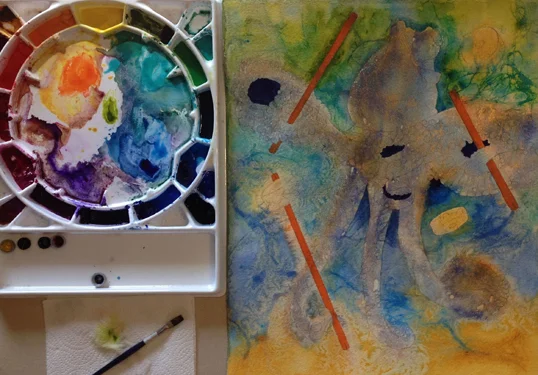
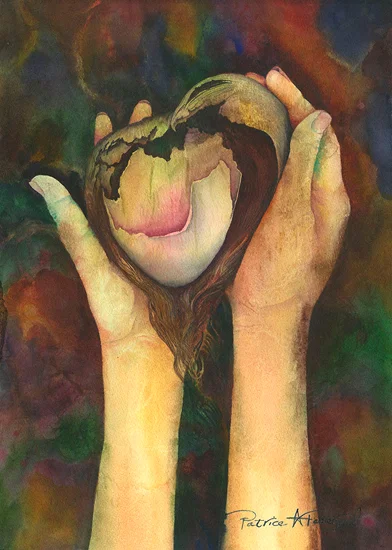
This painting took over a year to complete
because I didn't like what I saw … until it
rested. After taking it out of sequestration,
it looked much better, and I could finish
the painting. We don't always like our works 
in progress.

Okay. What if the night owls got it right and those birds aren’t singing for joy, they’re raging against the sun for waking them up?

What if it doesn’t really matter?

What if everything matters?

What if no one else cares? What if it’s up to us to care, or to not care?

What if we get to decide what life means, what specific incidents mean, and what we want to do (or not do) with the meaning we assign to them?

What if it really is up to us to make these decisions?

Are we ready to assign positive meanings to our actions and their results?

What if just because I didn’t get the results I want immediately, I get them later instead?

What if there is a time delay that I forgot to factor into my “I want it now” equation?

What if that dab of paint I just added to my painting looks all wrong now, but leads to another and another and another dab that ultimately makes this painting my best one yet?

What if we’re taking score too soon?

What if we can’t quite see the whole picture and we need more information?

People are surprised when I tell them that I don’t know what my painting will look like when it’s finished. Heck! If I knew at the beginning of the painting what the result would be, there would be no magic in the painting and no reason to paint!

I don’t want to know with absolute certainty what the painting will look like when it’s finished.

What if all we need to do is trust in the process and in our ability to reach an end, a point of completion?

And what if that point of completion morphs into a new question or better yet, a new beginning point for our next painting?

What if we looked at all of life, and every moment in it, as a point of possibility? What if even the “bad times” really do have silver linings, and if we look for them, they will find us?

"It is better to believe than to disbelieve; in so doing you bring everything to the realm of possibility." ~ Albert Einstein

What if the choice really is that simple, and what if it’s ours to make in every moment?

Wake Up Your Super Hero/Heroine

Sometimes I just have to laugh at myself. It’s so easy to make a decision after a cup of coffee in the morning when I’m feeling energized and excited about the day ahead. 

Do I want to start a new painting this afternoon? You bet I do!

The error is in thinking that one decision is going to make magic happen.

That’s not how it works.

If we only had to decide something once for it to be so, we would all be fit as a fiddle, be our “ideal” weight, have our dream career, and live happily ever after.
It’s the continuous action of making the same decision over and over again that makes the difference.

That’s why I can wake up in the morning feeling eager for the day ahead, excited to start a new painting later, and never start one.

Later in the day, after running errands, teaching a class, checking email, and eating lunch, my energy flags, and my early morning decision to start a new painting feels more like a job than a great idea.

That’s when I have to re-make the decision to start a new painting!

I don’t always follow through.

Instead I might decide to do an easier task, one that’s just as necessary, but probably less meaningful.

This is the decision point between doing my “genius work” and the myriad of business or life tasks we all face daily.

(We all have “genius work” — the work that only we can do. My “genius work” is painting, writing, and teaching. What’s yours?) 

It’s harder to make the “right” decision when we’re tired, sad, overwhelmed, depressed, or low for any reason.

This is the time to wake up your inner Super Hero/Heroine.

Really! We all have one. You knew this as a kid. Have you forgotten?

Your inner Super Hero is still inside you, waiting to be called forth. It might sound strange, but it’s actually pretty easy to do.

Take five minutes right now and go stand in either the “Wonder Woman” or “Super Man” pose. 

You know the pose — your feet are planted 2–3 feet apart, your fists are either on your hips or your arms are raised in a “V”. 

Do this pose for five minutes and You Will Feel ENERGIZED!

This quiet activity can be done as often as you like with no adverse side affects. It’s cheaper than a cup of coffee or an energy drink, and far better for you.

If you are at work, or not alone, imagine standing in the pose.

When done with your pose, rethink the decision you were about to make, and “May the force be with you.”

Go do your “genius work”!

Abandon Control

A few weeks ago I taught a really fun class at the Honolulu Museum of Art Spalding House Campus: Pored Paintings.

Students love this class because it gives them a chance to completely lose control of the painting process right from the start.

Pat San Souci taught me the process about ten years ago. I wasn’t sure I really wanted to learn the process because I wasn’t interested in losing control (I can be a bit of a “control freak”). 

Then I found out just how much fun being out of control can be!
Pat’s class was the most fun I had ever had painting up until then.

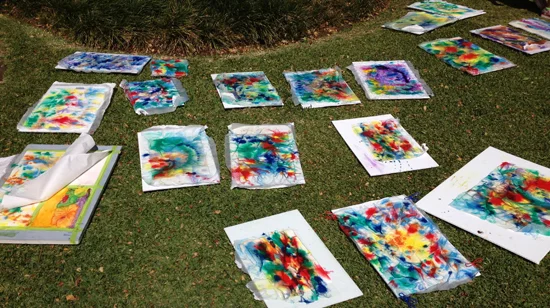
The gist of the process is to pour watercolor paint through a filter paper onto wet watercolor paper.

If you’ve ever painted wet-into-wet (wet paint on wet paper) you know the paint spreads and moves F•A•S•T!    

Tongue-in-cheek, I began to demonstrate the technique to my class by telling them that I would be painting two yellow hibiscus flowers.

I poured the paint within 60 seconds, and quickly took the wet painting outside to dry in the sun.

For the next 30 min, each student poured 2–4 painting starts and took them outside to dry.

30 minutes later, we brought all of the paintings inside. One by one we set them on the easel at the front of the class to see what we had created.

At this point all of the paintings were quite abstract. Yet as we turned them around and around, we could begin to see that we might coax something representative out of them to create our paintings.

I put my painting on the easel to demonstrate the next step and reminded the class that I would be painting yellow hibiscus.

The joke was on me! Everyone laughed and Sandy said, “I think you have a parrot there.”

Sure enough, a very Sassy Parrot dared me to turn him into a yellow hibiscus.

Rather than argue with him, I surrendered and began the very slow process of painting my first parrot. 

A week later, I discovered another parrot on the page, along with some hibiscus.

Yes, it can be nice to feel like we have control, and a painting turns out just as we’ve planned.

But honestly, it’s way more fun when we get out of the way, and let the painting tell us what to paint.